

The florida state bird is the NORTHERN MOCKINGBIRD, which can mimic the sounds of other birds, and even mechanical noises.
It is in Florida where this clever and adaptable bird would flourish in every habitat —in the city and in the country.
Famous for its melodious tunes, the Northern Mockingbird is vital to Florida’s natural environment.
In this post, we’ll discover its traits, environment, and importance to our state.
Key Takeaways
- The Northern Mockingbird, Florida’s state bird since 1927, was selected for its popularity and adaptability, epitomizing the spirit of endurance among Florida’s fauna.
- This bird is 8.5 to 10 inches long, with a 12 to 13 inch wingspan and gray feathers with white undersides and wing patches, which make it easily recognizable.
- Renowned for its exceptional singing ability, the Northern Mockingbird can imitate a wide range of sounds, with male birds having up to 200 different song variations, making it a favorite among bird watchers.
- It’s territorial, diurnal and omnivorous — feasting on insects, fruit and even small reptiles — showing a certain adaptability in its diet.
- Nesting is often in thick cover, with the females laying 2-6 eggs and both sexes taking care of their young, so safe nesting sites are important.
- The recent controversy over the Northern Mockingbird as Florida’s state bird is indicative of wider debates surrounding wildlife conservation and the cultural significance of state emblems.
Florida's Official State Bird
Florida’s Official State Bird, the Northern Mockingbird, has held the title since 1927. Known for being resourceful and a favorite among many birders, this prolific bird has become an avian symbol in Florida’s wildlife. Its bold gray feathers and incredible ability to mimic human speech make it an iconic bird in the sunshine state.
Identification
The Northern Mockingbird is 8.5 to 10 inches (21-25 cm) long. Its wingspan measures 30 to 33 cm (12 to 13 in) allowing it an agile flight for quick darting.
Its unique gray color is accented by white undersides and wing patches that are readily observed in flight. Its long tail and slightly decurved bill are important identification characteristics. These traits render it identifiable across environments, from city parks to backyard gardens.
Vocalization
Famous for its remarkable singing aptitude, the Northern Mockingbird is capable of imitating a variety of sounds such as the calls of other birds, insects, frogs and even machines. This remarkable songbook is important in attracting mates and marking territories.
Male mockingbirds are especially recognized for their intricacy, typically singing as many as 200 unique songs. These calls not only captivate bird-watchers, they illustrate the bird’s acclimation to its habitat.
Their songs are a big draw for birdwatchers, highlighting the Northern Mockingbird’s special charm.
Behavior
Florida’s state bird, the Northern Mockingbird, is the opposite of a social bird, as it tends to be very territorial. This is especially true during breeding season when males spend most of their days being active establishing and maintaining territory.
Its omnivorous menu demonstrates versatility — eating everything from insects and fruits to little reptiles. Social interactions are important, with mockingbirds bonding with their mates and raising their young as a team.
This social behavior contributes to their thriving in different environments.
Diet
Their diet is varied, including insects, fruits and small reptiles. Their distinctive feeding technique, called gaping, enables them to extract fruit juices.
Such a feeding tendency is vital in limiting insect populations in their habitats, highlighting the mockingbird’s ecological significance. Their cunning opportunism allows them to succeed in habitats ranging from the city streets to the remote country roads.
Nesting
They’re nesting habit is often observed in dense vegetation where Northern Mockingbirds form nests from twigs, grass and other materials to camouflage them.
There are 2-6 eggs laid by the females and both parents tend to the young. Nesting sites are important in suburban locations and parklands throughout Florida.
Florida state bird: Northern Mockingbird [Gallery]
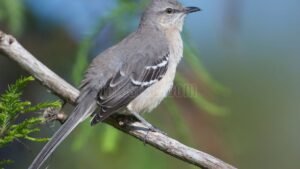
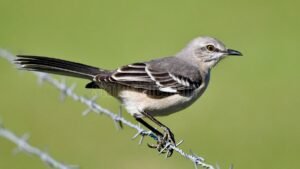
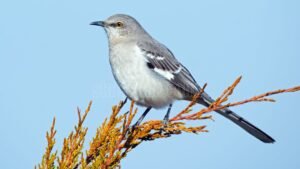
Florida state bird: How to draw Northern Mockingbird [outline]


The Selection Story
The Northern Mockingbird has been Florida’s official state bird since 1927. Its selection occurred at a time when there was increasing interest in encouraging state emblems that highlighted indigenous animals. The mockingbird was selected because of its adaptability and common presence across Florida. For 95 years, it’s been ubiquitous in cities and the countryside, representing that link to the natural world that so many Floridians enjoy.
The state bird movement has transformed, becoming an effort to publicize wildlife conservation. Supporters say it gives citizens a sense of stewardship toward native species. Although the mockingbird has filled this duty, some think it might not be the most suitable ambassador for Florida’s distinctive bird life anymore. There’s controversy about whether to replace it with a bird more specifically linked to the state.
Suggestions like the American Flamingo, which is indeed native to Florida, have emerged as main contenders. This bird’s colorful feathers and gregarious nature might represent Florida’s bountiful natural character. However, the flamingo is only prevalent in select coastal regions, raising the question of whether it truly symbolizes the state as a whole.
Another candidate is the Florida Scrub Jay — a rare bird with just 4,000 or so left, mainly in central Florida. Its family behavior and hard-working appeal connect with many Floridians. Amid these debates, the mockingbird’s advocates contend that its melody and flexibility continue to symbolize the soul of contemporary Florida.
Critics argue that as the state has become increasingly urban and less rural, the mockingbird may no longer represent the modern-day image of Florida. It’s not the first time we’ve tried to change the state bird — back in ’99, a push to make the scrub jay our state bird was met with cynicism, considered by some to be a money grab attached to environmental protection.
With the Florida legislative session looming, it’s unclear what lies ahead for the mockingbird. With state lawmakers supporting both sides of the debate, the discussion around Florida’s state bird is far from over. Stakeholders want to ensure that whatever is chosen will boost conservation efforts and be representative of all Floridians.
A Controversial Choice?
Isn’t that a controversial choice for our official state bird? Although the Northern Mockingbird has long held the title since 1927, many residents don’t think it’s the most appropriate representative of the state. Naturally, the controversy revolves around the assertion that our state-unique Florida scrub jay should be the one to receive this recognition as the new state bird.
Advocates for the Florida scrub jay tout its status as being found only in Florida. While the Northern Mockingbird, which happens to be the state bird of four other states (Arkansas, Mississippi, Tennessee, and Texas), never leaves Florida, the scrub jay does. For this reason alone, it’s a more genuine representation of the state’s bird legacy.
In addition, scrub jays are interesting critters in their own right, including cooperative breeding. Yearlings frequently help rear new broods – a great social aspect to these community-minded birds. Even Floridians disagree on their opinion of the scrub jay, with some considering it ‘mischievous’ and others noting its ‘impressive intelligence’.
This nuance makes it all the more compelling to acknowledge. Detractors note the Northern Mockingbird’s tendency to sing all night long, especially on full moons. This has resulted in calls for a more truly representative Florida state bird.
Legislators have tried numerous times to switch the state bird, suggesting the wild flamingo as well as the scrub jay. These conversations expose a more general feeling about the place of state symbols in contemporary Florida. A lot of people feel that those symbols ought to be about local pride and distinctiveness, as much as the state itself.
There it is, the Northern Mockingbird, standing tall. There’s more at stake than just the symbolic when it comes to keeping this moniker–it’s a conservation issue. A state bird can be a rallying point for conservation, bringing attention and funding to species that require protection.
The threatened scrub jay would be a particularly good candidate for such attention, especially given its status as an endemic bird in the state.
The Mockingbird's Florida
The Northern Mockingbird, designated as Florida's state bird, can be found across the entire state, from the lush landscapes of the panhandle to the subtropical allure of the Florida Keys. This bird fares well in all habitats, showing its activity and flexibility.
The map below illustrates the distribution of Northern Mockingbirds throughout Florida, highlighting their presence in different regions:
|
Region |
Distribution |
Preferred Habitats |
|---|---|---|
|
Panhandle |
Common |
Open woodlands, fields, gardens |
|
North-Central Florida |
Very Common |
Urban parks, residential areas |
|
Central Florida |
Very Common |
Suburban neighborhoods, citrus groves |
|
South Florida |
Common |
Coastal areas, palm groves |
|
Florida Keys |
Present but Less Common |
Sandy beaches, scrubland |
Northern Mockingbirds seek out habitats that offer a balance between open areas and shrubbery, enabling them to scavenge for sustenance while being protected. They feed primarily on insects, fruit and berries in gardens, parks and natural areas.
The Northern Mockingbird is a symbol of adaptability. They’ve made suburbs their home, effortlessly adapting to human presence. In city parks and suburban gardens, they frequently nest in bushes or trees, taking advantage of plentiful nourishment and safety from hunters.
Thriving in these environments is what makes them such a ubiquitous Florida bird, which you hear and see everywhere. Because of their year-round presence, Northern Mockingbirds are a familiar sight to locals and tourists alike.
They don’t migrate out of Florida for the winter. No, they remain, saturating the atmosphere with their diverse melodies and cries. Their voices are renowned, as they imitate other birds and even machinery, making their presence uniquely charismatic in both urban and wild environments.
Ecological Role
Florida’s state bird, the Northern Mockingbird, is an important ecological player. This tiny, nimble creature isn’t only a tuneful visitor to gardens and parks – it’s a key player in maintaining the equilibrium of native ecosystems.
One of the Northern Mockingbird’s most important ecological roles is as an insect controller. These birds consume a range of insects such as caterpillars, beetles, and spiders. In consuming such species, they play a role in regulating insect populations, curbing possible outbreaks that can damage plant life and upset local ecological balances.
To illustrate, one mockingbird can eat hundreds of insects in a day — showing that it’s an essential natural pest controller.
|
Ecological Contribution |
Description |
|---|---|
|
Insect Control |
Consumes various insects, reducing their populations. |
|
Indicator Species |
Reflects the health of its habitat and environment. |
|
Biodiversity Enhancement |
Supports diverse plant and animal life in ecosystems. |
The Northern Mockingbird also serves as an indicator species, meaning its presence and health can reflect the overall condition of its environment. A flourishing community of mockingbirds often indicates a robust environment, abundant in sustenance and optimal living conditions.
Population decreases can serve as a warning of environmental threats like pollution or destruction of habitat. This ability renders them precious to ecologists and conservationists who keep track of environmental shifts.
Mockingbirds are a part of Florida’s biodiversity. They’re famous for their wonderful mimicking of other birds’ songs and sounds in their environment. This habit not only decorates the soundscape but functions in mate attraction and territorial displays.
Their varied diet of fruits and berries assists in seed dispersal, helping to regenerate plant life and maintain biodiversity. For instance, when mockingbirds eat berries and later poop out the seeds, they nurture new growth that sustains other critters.
Cultural Resonance
There is perhaps no other bird that resonates with the Florida culture as does the Northern Mockingbird. As the official state bird, it represents resilience and adaptability, characteristics that echo the spirit of both the Floridian landscape and its inhabitants. This isn’t just a bird; it’s an avian symbol of the hometown spirit–a testament to the concord between the natural world and mankind.
Art and poetry often find muse in the Northern Mockingbird. In verse, it’s a metaphor for liberty and the imagination, represented as an untamed song. Local artists weave its image into paintings and sculptures, encapsulating its energetic presence in the state’s vistas, making it a favorite bird among many.
The bird is prominent in folklore. Generations of stories have told of its enchanting tunes that can either foretell fortune or herald transformation. These stories add to Florida’s cultural resonance, making residents feel linked to their wilderness and the beauty of its wildlife.
Birders admire the Northern Mockingbird for its idiosyncratic behaviors and vocalizations. These prolific birds are famed for their vast songbook, borrowing the calls of other birds, making them a collector’s favorite. Birding expeditions and communal rituals frequently center on these mimics in the wild.
These types of activities encourage environmental consciousness and build a sense of community among the participants. Through birding, natives and tourists alike gain a greater respect for Florida’s biodiversity.
The mockingbird represents Florida’s natural legacy, echoing the significance of preservation. Its ubiquity in city and countryside emphasizes conservation of habitat and encouragement of biodiversity. Conservation organizations in Florida have latched on to the mockingbird in their campaigns.
Outreach programs and workshops highlight the importance of this bird, inspiring listeners to preserve their own backyards. By identifying the mockingbird as an emblem to be treasured, Floridians are called to duty in safeguarding that environment for those who follow.
Conclusion
Floridas state bird mockingbird unique history not only a bird that is important to our ecosystem but one that is so entwined in our culture and own identity as a state. Its choice was controversial, but most people love its versatility and appeal. The songs of the mockingbird blanket the Florida air. Knowing about this bird’s importance brings us closer to the wild world surrounding us. Interacting with local creatures provides us a connection to our environment. Discover the magic of Florida’s wilds, and hear the music of the mockingbird in your own backyard.
Frequently Asked Questions
What is Florida's official state bird?
The Northern Mockingbird, an iconic bird, became known as Florida's official state bird in 1927 due to its prolific presence.
Why was the Northern Mockingbird chosen?
The Northern Mockingbird, a prolific bird, was selected for its adaptability and capacity to flourish in many habitats throughout Florida, serving as a genuine emblem of the state’s diverse environment.
Is there any controversy surrounding this choice?
Yeah, yeah, I know, there are those fools out there who say that other birds, like the iconic scrub jay, would better represent Florida’s distinctive ecosystems. The Northern Mockingbird remains a favorite bird due to its common presence and beautiful song.
What role does the Northern Mockingbird play in Florida's ecology?
The Northern Mockingbird, a prolific bird and favorite among birders, is essential for pollination and seed dispersion, contributing to the health of modern Florida's ecosystem.
How does the Northern Mockingbird resonate culturally in Florida?
The Northern Mockingbird, a prolific bird and avian symbol of Florida, is honored in poetry and song as a representation of nature’s grace in the sunshine state.
Where can I see Northern Mockingbirds in Florida?
Northern Mockingbirds are frequently seen in cities, parks, and gardens across Florida, making them a favorite bird among birders for their unique songs and behavior.
How can I attract Northern Mockingbirds to my yard?
To entice Northern Mockingbirds, cultivate indigenous fruit-bearing shrubs and trees, as these beautiful birds are prolific in modern Florida.
Related Posts

How Much Are Abortions in Florida? Affordable Options & Info
Spread the loveDid you know that the cost of abortions at Planned Parenthood in Florida, including p...

What Time Does It Get Dark in Florida? Find Out Florida Sunset Times!
Spread the loveHave you ever wondered what time the day length reaches its shortest point in Florida...

How Much Does a Firefighter Make in Florida 2023?
Spread the loveDid you know that understanding firefighter salaries in Florida is crucial for intere...

What is Florida's State Flower? Discover the Orange Blossom!
Spread the loveAre you curious about the official flower of Florida? Get ready to delve into a world...